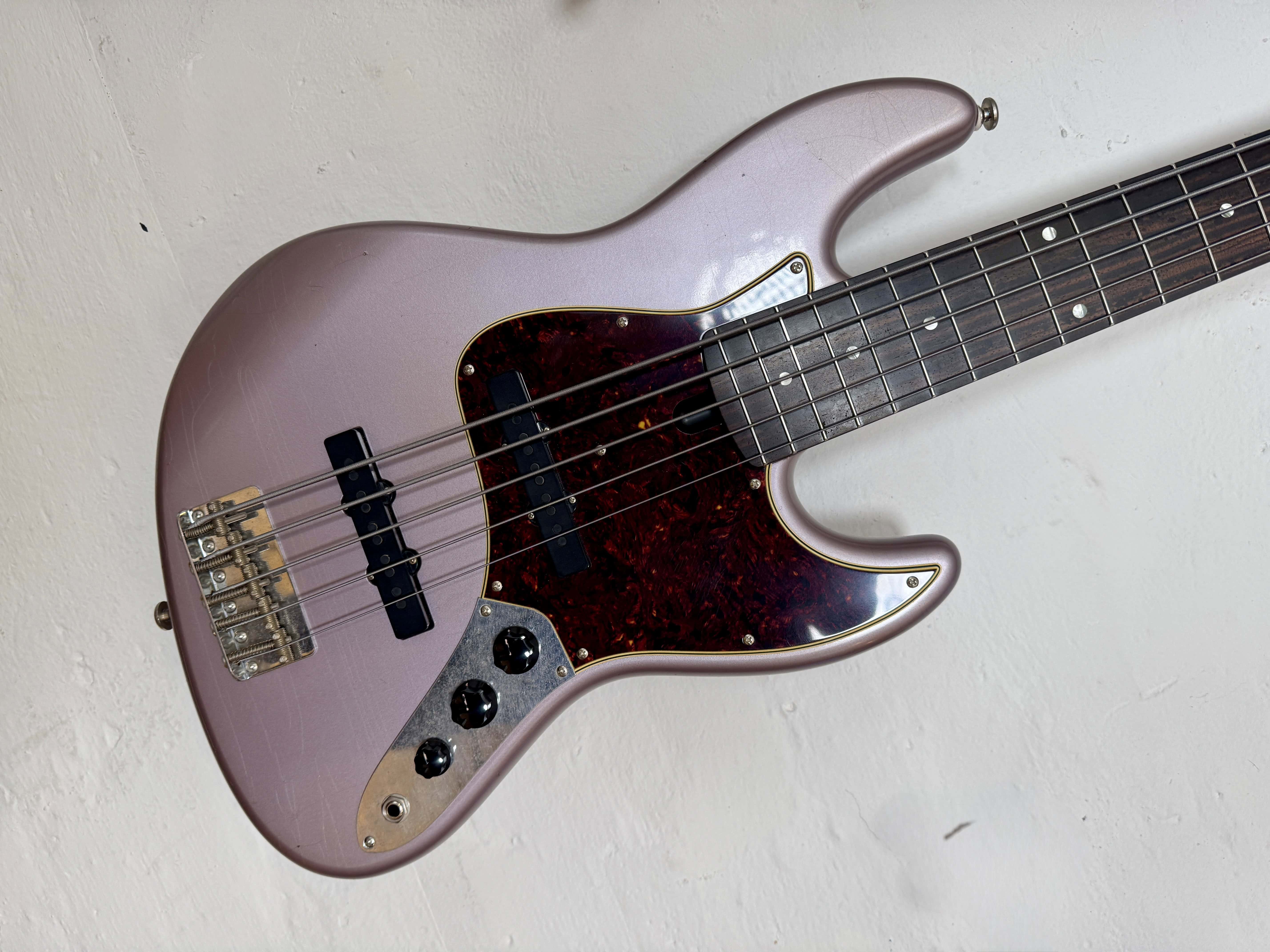
De Gier Bebop Classic 5 Evening Orchid Relic
You might also want to connect with us on Facebook, YouTube, Instagram, or by email.
Out of stock
Bebop Classic 5 Evening Orchid Relic
Sander de Gier has been building instruments in his workshop in Heinenoord, just south of Rotterdam, since 1996, and the Bebop Classic is the most single-minded bass he makes. His own brief for it is blunt: the best vintage Jazz bass available, other than a real vintage Jazz bass. So there is no preamp and no modern add-ons. You get a steel bridge, a thin nitro finish, small frets and vintage-voiced pickups, each chosen because you can hear what it does.
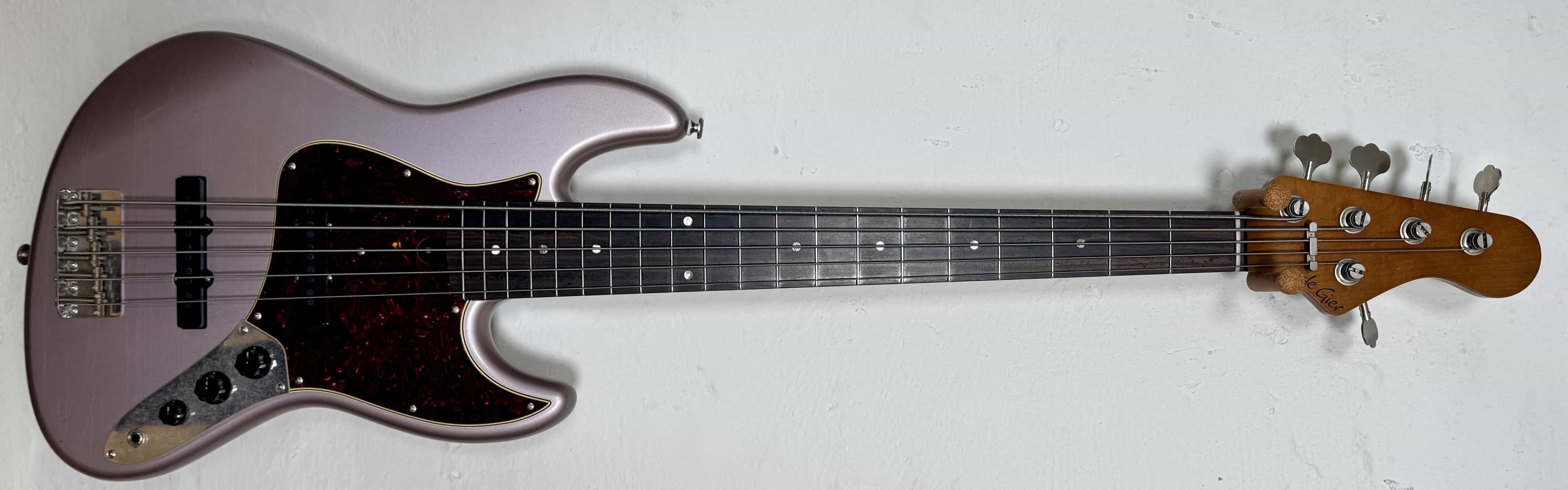
This is Bebop number 468, a five-string in Evening Orchid, a pale metallic lilac borrowed from mid-sixties American cars. In warm light it leans pink, in daylight it goes cool and silvery. The finish has been aged by hand with fine scratches and dings across the body, the control plate has gone properly grey, and the headstock is left in tinted maple. What sets this one apart from the Bebop Classics we have had before is the fingerboard, which is Ceylon ebony instead of the usual rosewood.
A sixties Jazz recipe with an ebony board and a pair of Kloppmanns. It's the tightest, clearest Bebop Classic we've had in the shop.
Body, Neck & Woods
The body is alder, the most even-handed wood in the Jazz Bass tradition. It gives a punchy but controlled low end, a midrange that comes forward enough to cut through a loud band, and highs that stay open without turning glassy. Alder stays out of the way and lets the pickups and the neck decide what the bass sounds like, which suits electronics this simple.
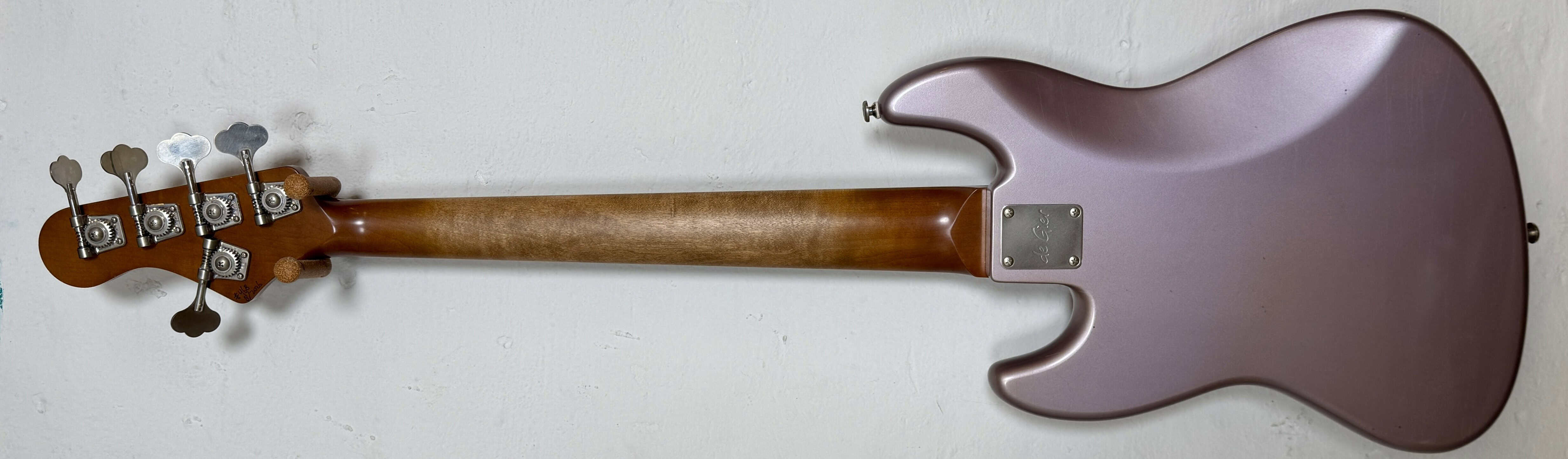
Over that goes a thin coat of nitrocellulose in Evening Orchid, and then the relic work: fine scratches on the top, a few dings along the edges and hardware dulled to match. The story behind the wear is beside the point. A thin, aged nitro finish lets the body resonate more freely than a thick poly coat, and the bass arrives already broken in.
The neck is hard maple, bolted on, with an amber tint and a C profile. The fingerboard is Ceylon ebony with dot inlays, dark brown with black streaks running along its length. Ebony is harder and denser than rosewood, and you hear it in the front of the note: a quicker, cleaner attack, a firmer low B and a little more definition when the lines get busy. On a passive Jazz-style bass that is a nice pairing, because the extra clarity comes from the wood and not from an EQ.
The board has a 7.5″ to 12″ compound radius, round and vintage-feeling at the nut and flatter as you climb. There are 20 frets in small, vintage-size wire, which puts more of your fingertip on the wood and gives a woodier, more immediate note. The 34″ scale and 46 mm nut keep the five-string neck in familiar territory, and the strings sit 19 mm apart at the bridge, close enough to move around quickly and wide enough to slap on.
Electronics, Sound & Feel
The pickups come from Kloppmann Electrics in Germany, where Andreas Kloppmann winds them by hand. This is a new set that Kloppmann has designed specially for De Gier. The pole pieces follow the radius of the fingerboard, and they are placed to match the exact string spacing of this bass. Every string sits right over its magnets at the same distance, so the output is even from the low B to the G and no string jumps out or falls behind. The voice is the old single-coil sound done properly: tight, articulate lows, a vocal midrange that carries a line through a mix without EQ help, and a top end with air in it that stops short of harsh.
The circuit is Volume, Volume, Tone, passive, straight to the jack. With both volumes up you get the classic scooped two-pickup sound. Roll the bridge pickup back a little and the neck pickup takes over with a rounder, darker weight. Favour the bridge and you get the nasal, mid-forward growl that cuts through a horn section. The tone control covers the rest, and with nothing else in the signal path the bass responds to your right hand and to your amp, with no preamp shaping things in between.
The hardware follows the same thinking. De Gier’s own steel bridge with threaded saddles feeds sustain and low-end definition back into the body, and Res-o-lite tuners keep weight off the headstock so the five-string neck doesn’t dive on the strap. All of it is aged to match the body, including the control plate and the screw heads.
We think this is a bass for the player who has already decided that passive is not a limitation. If you want a five-string for soul, funk, gospel, jazz or session work that sounds like a great old Jazz bass, with a low B that works and a bit more snap than the rosewood versions, this is the one to try. It comes in the De Gier leather gig bag, and in this spec, with Evening Orchid, ebony board, tortoise guard and Kloppmann pickups, it’s a one-off.
Specs
Body
- Body Wood
- Alder
- Color
- Evening Orchid metallic
- Finish
- Thin nitrocellulose, hand-relic'd, with aged hardware
Neck
- Neck Wood
- Hard maple, bolt-on, amber tint
- Fingerboard
- Ceylon ebony with dot inlays
- Scale
- 34"
- Fingerboard Radius
- 7.5" to 12" compound
- Neck Shape
- C
- Nut Width
- 46 mm
- String Spacing
- 19 mm at bridge
- Frets
- 20, small vintage-size
Weight
- Weight
- TBA
Electronics
- Pickups
- Kloppmann Electrics hand-wound Jazz single-coils, designed for De Gier, pole pieces radiused to the fingerboard and matched to the string spacing
- Controls
- Volume, Volume, Tone
- Preamp
- None, fully passive
Hardware
- Pickguard
- Tortoiseshell
- Bridge
- De Gier steel vintage-style with threaded saddles, aged
- Tuners
- Res-o-lite
- Hardware Finish
- Aged nickel
- Includes
- De Gier branded leather gig bag
