Musicman StingRay Pre-Ernie Ball Natural (pre-owned)
In stock
StingRay — Natural, Pre-Ernie Ball, 1979
In 1976 Leo Fender, Forrest White and Tom Walker put a humbucker and an active preamp into a bolt-on bass and called it the StingRay. It was the first production bass with onboard active EQ, and it changed what a bass was allowed to sound like — the hard, scooped, piano-string bark that ran through funk, disco, rock and everything Flea and Bernard Edwards ever played came from this design. The early ones were built by Leo’s own CLF Research in Fullerton, California, and those pre-Ernie Ball instruments are the ones collectors and players argue about.
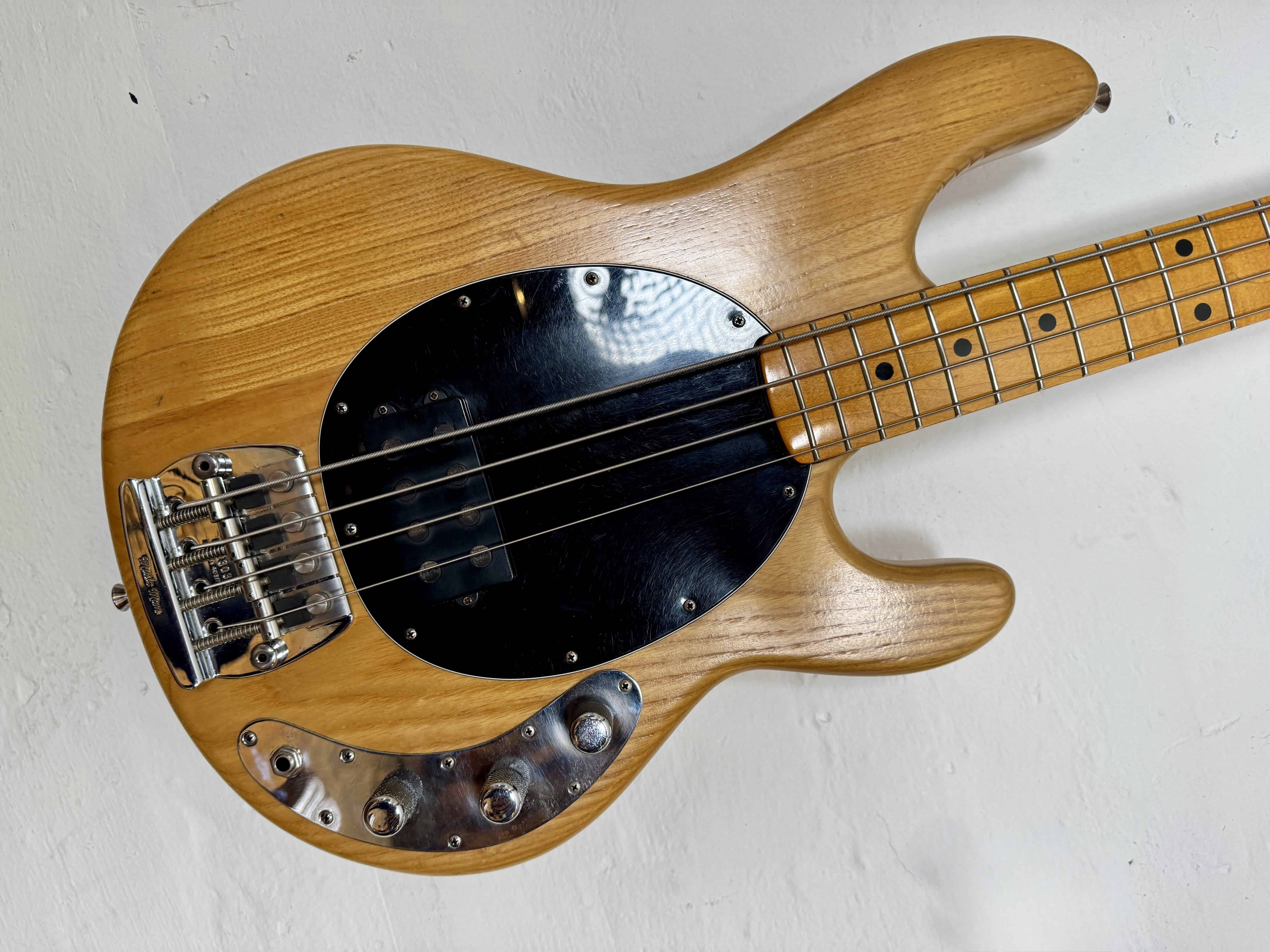
This is a 1979, right in the heart of that run. Natural ash body, one-piece maple neck with a maple board, the 3-bolt micro-tilt neck joint, the 3+1 headstock, the string-through bridge with its four individual mutes, and the original alnico humbucker and 2-band preamp still in place. Serial number B013039 on the bridge plate. It’s in really good condition for a bass that’s been around for forty-odd years — the natural finish has aged to a warm amber, the chrome has a light patina, and the maple board has darkened where hands have been — and it comes in its original Music Man hardshell case.
At 4.73 kg it sits on the lighter side of what these ash-bodied Rays usually weigh, which matters when you’re two sets into a night with a slab body on your shoulder.
A pre-EB StingRay doesn't sound like a StingRay. It sounds like the reason every other StingRay exists.
Body, Neck & Woods
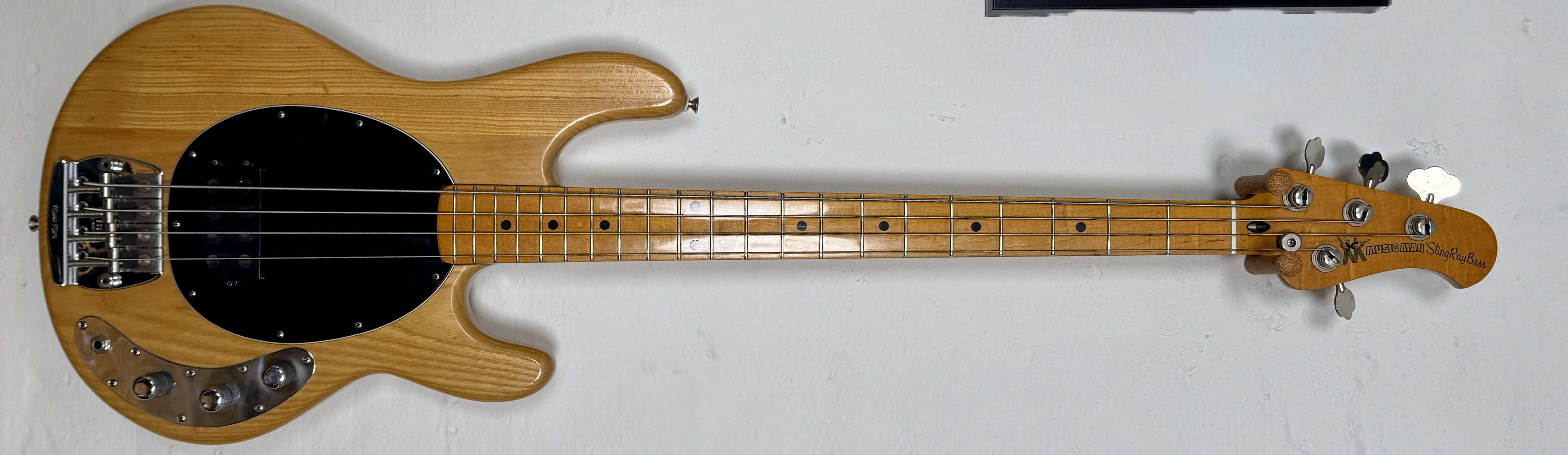
The body is ash under a transparent natural finish, so the grain is right there — long, open pore lines running the length of the slab. Ash is the reason a StingRay attacks the way it does: it’s hard and bright and it pushes the note out fast, with a snap on the front end and a low-mid punch that lets the bass sit forward in a band without a lot of amp help. On a pre-EB the body is the uncontoured slab shape with square edges, thicker and heavier than the later contoured bodies, and that extra mass is part of the sound — there’s more fundamental under the bark than a modern Ray gives you.
The neck is a one-piece maple with the walnut skunk stripe down the back, 21 frets on a maple fingerboard with black dots and a 7.5-inch radius. That radius is rounder than anything Music Man makes today and it’s a big part of why an old Ray feels the way it does under your fretting hand — the board curves into your palm, chords and octaves lie naturally, and with a decent setup it still plays clean up the neck. The nut is 1-5/8 inches, a touch narrower than a Precision, on a 34-inch scale.
The neck bolts on with three screws and a micro-tilt adjuster — the same system Leo used at CBS Fender, and it does exactly what it says: a set screw under the plate lets you set the neck angle without shims. The 3+1 headstock is the other thing you notice straight away, and it isn’t a styling choice — putting the G tuner on the opposite side gives every string a straight pull over the nut, which keeps tuning stable and lets the bass get away with a single small string guide instead of a tree.
Condition
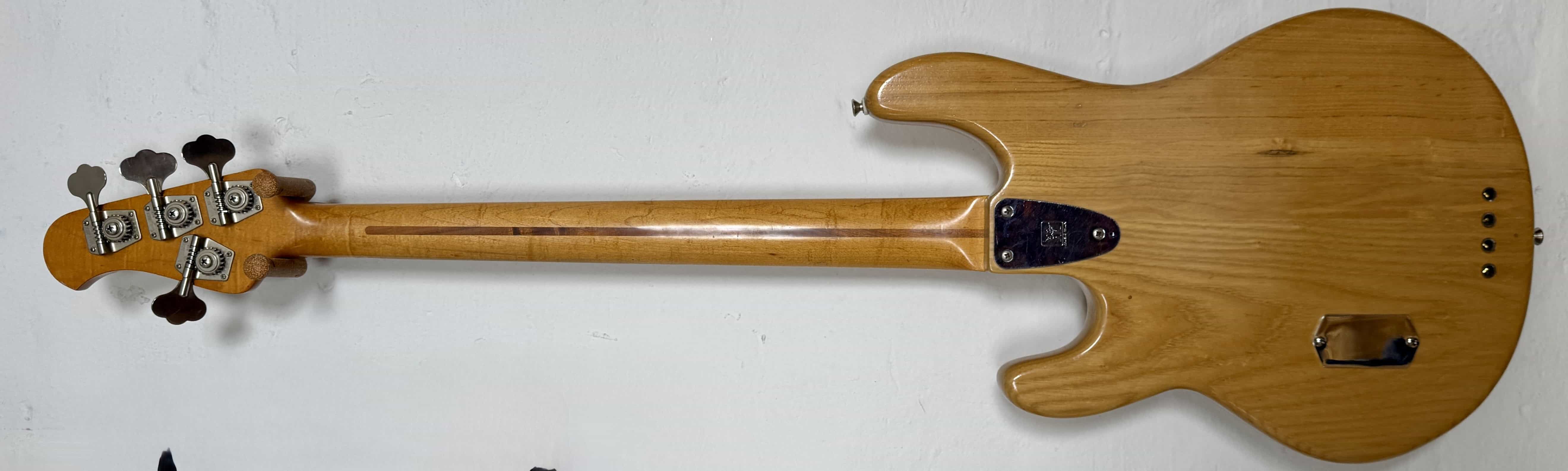
Really good condition for a 1979. The natural finish has aged to a warm amber over the decades and shows the light, honest marks of a bass that’s been played rather than parked — a few small dings and some finish wear along the edges and the lower bout, and a little belt-buckle wear on the back. The chrome on the bridge, the control plate and the neck plate has a light patina rather than pitting, and the maple fingerboard has darkened where it’s been played most, which is exactly what you want to see on a maple-board Ray from this era — it hasn’t been refinished or sanded back. The frets have plenty of life left and the neck is straight, so it sets up low and plays clean all the way up.
The important parts are original: the alnico humbucker, the 2-band preamp, the string-through bridge with all four mute pads still in place, the 3+1 tuners and the black oval pickguard. Serial number B013039 is stamped on the bridge plate where Music Man put it in this period. It comes in the original Music Man hardshell case — the case is worn, as forty-six years of gigs will do, but it closes, it latches and it protects the bass. If you want closer photos of any detail — the neck heel, the fret wear, the back of the headstock, the case — just ask and we’ll send them over.
Electronics, Sound & Feel
The pickup is the original Music Man humbucker with alnico magnets and the eight big pole pieces, sitting in the sweet-spot position between the middle and the bridge that Leo settled on in 1976. It’s wound fairly hot for a bass pickup, and combined with the wide magnetic window of a humbucker it gives you that thick, growling midrange with a hard edge on top — the sound that makes a StingRay cut through a mix that would swallow a Jazz Bass. Played with a pick it barks; played fingerstyle near the bridge it’s tight and percussive; slapped, it’s the sound of every late-seventies record you’ve ever tried to learn.
Behind it is the original 2-band preamp, running on a single 9-volt battery in the compartment on the back. This one has the later pre-EB circuit board rather than the early epoxy-potted brick, which is good news if it ever needs a service — the potted units can’t be repaired, the open boards can. Three knobs on the chrome plate: volume, treble and bass, with the two EQ controls giving boost and cut. The 2-band is the one people mean when they talk about a real StingRay preamp — the treble control opens up the top end without getting brittle, and the bass control adds weight under the fundamental without turning to mud. There’s no mid control, and that’s not a shortcoming: the mids are built into the pickup and the ash body, so what you’re doing with the EQ is shaping around a sound that’s already there.
The string mutes on the bridge are the detail modern Rays lost. Four individual foam pads on screws let you damp each string as much or as little as you want — dial them in and you get a thumpy, short-sustain, old-school tone that sounds like a flatwound Precision through a tweed cabinet, back them off and the bass rings out. It’s a whole second voice, and it’s built into the hardware.
Who is this for? Anyone who’s played a modern StingRay and wondered why it doesn’t quite sound like the records — this is why. The slab ash body, the 7.5-inch maple board, the alnico pickup and the 2-band preamp together are the original recipe, and the pre-EB Fullerton-built basses are the ones that hold their value. We’ve had several 1977, ’78 and ’79 StingRays through the shop, and the naturals are the ones that go first: you can see the ash, the finish ages beautifully, and this one, at 4.73 kg, is one you can actually gig with. If you’ve been waiting for a real one, this is a real one.
Specs
Body
- Body Wood
- Ash
- Colour
- Natural
- Finish
- Transparent gloss polyester
- Pickguard
- Black, oval — original
- Control Plate
- Chrome
- Neck Joint
- 3-bolt with micro-tilt adjustment
Neck
- Neck Wood
- Maple, one-piece with skunk stripe
- Fingerboard
- Maple, black dot inlays
- Radius
- 7.5"
- Scale
- 34" (864 mm)
- Frets
- 21
- Nut
- 1-5/8" (41.3 mm)
- Headstock
- 3+1 tuner layout
Electronics
- Pickup
- Original Music Man alnico humbucker, 8 large pole pieces
- Preamp
- Original 2-band active, 9 volt — later unpotted circuit-board version
- Controls
- Volume, treble, bass
Hardware
- Bridge
- Original Music Man string-through-body with four adjustable string mutes
- Tuners
- Original Music Man, 3+1
- Hardware Finish
- Chrome
- Serial Number
- B013039 — stamped on the bridge plate
Weight
- Weight
- 4.73 kg
Accessories
- Case
- Original Music Man hardshell case — worn, but it does the job
- Case Candy
- Not included
- Strap & Cable
- Not included