Mattisson Custom Series 5 Flamed Ash (pre-owned)
In stock
Mattisson build in small numbers in Sweden, and they build to their own recipe rather than to a market. This is a Custom Series five, and the spec reads like a list of decisions rather than a list of features: a mahogany core with a figured ash top left natural under satin, a five-piece maple, padouk and wenge neck finished in wax, an ebony board with a zero fret at the top of it, 24 frets, and hardware chosen purely for what it does rather than for whose name is on it. Nothing here is decorative and nothing is there because the catalogue expected it.
We have had this exact bass through the shop before. It has come back with new pickups – the passive Delano dual coils are gone, and there is now a pair of EMG 40TW-X in their place. That is a genuine change of voice rather than a swap of parts, and the rest of the instrument is exactly as it was: same woods, same neck, same geometry, same price. It is in mint condition – no buckle rash, no fret wear, nothing on the satin top or the back of the neck. It looks like it came off the bench, because it has barely been played since it did.
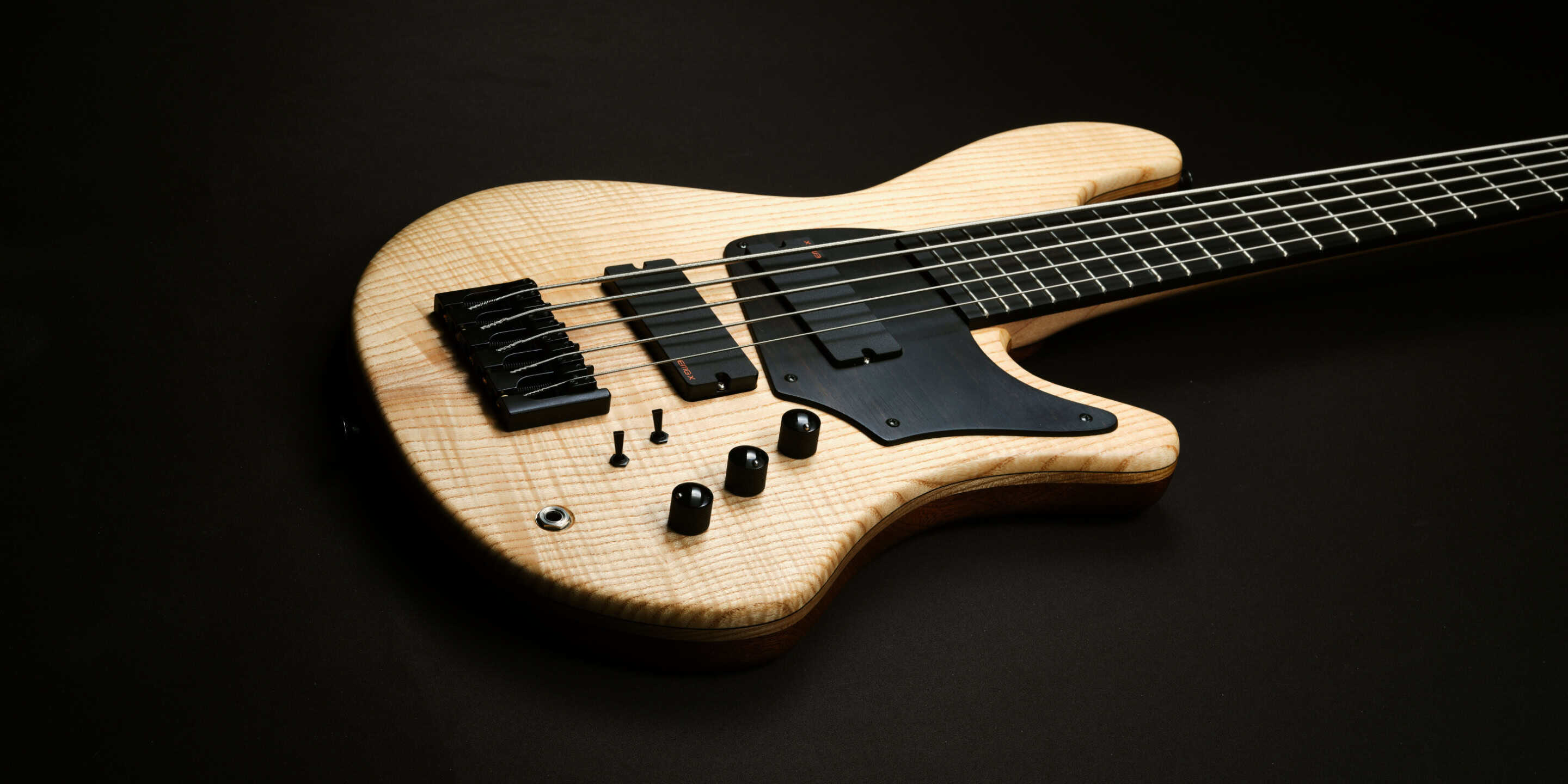
One thing to know up front, because you will notice it on the photos and again when you pick it up: there are two mini toggles on the lower bout that are not connected to anything. They are producer switches – the oldest running joke in session bass, the one Lee Sklar is best known for. Somebody in the control room asks for a different sound, you flip the switch, everybody nods. They can be wired up to do real work if you would rather they did.
Two of the toggles are wired to nothing at all. Everything else on this bass is wired straight to the point.
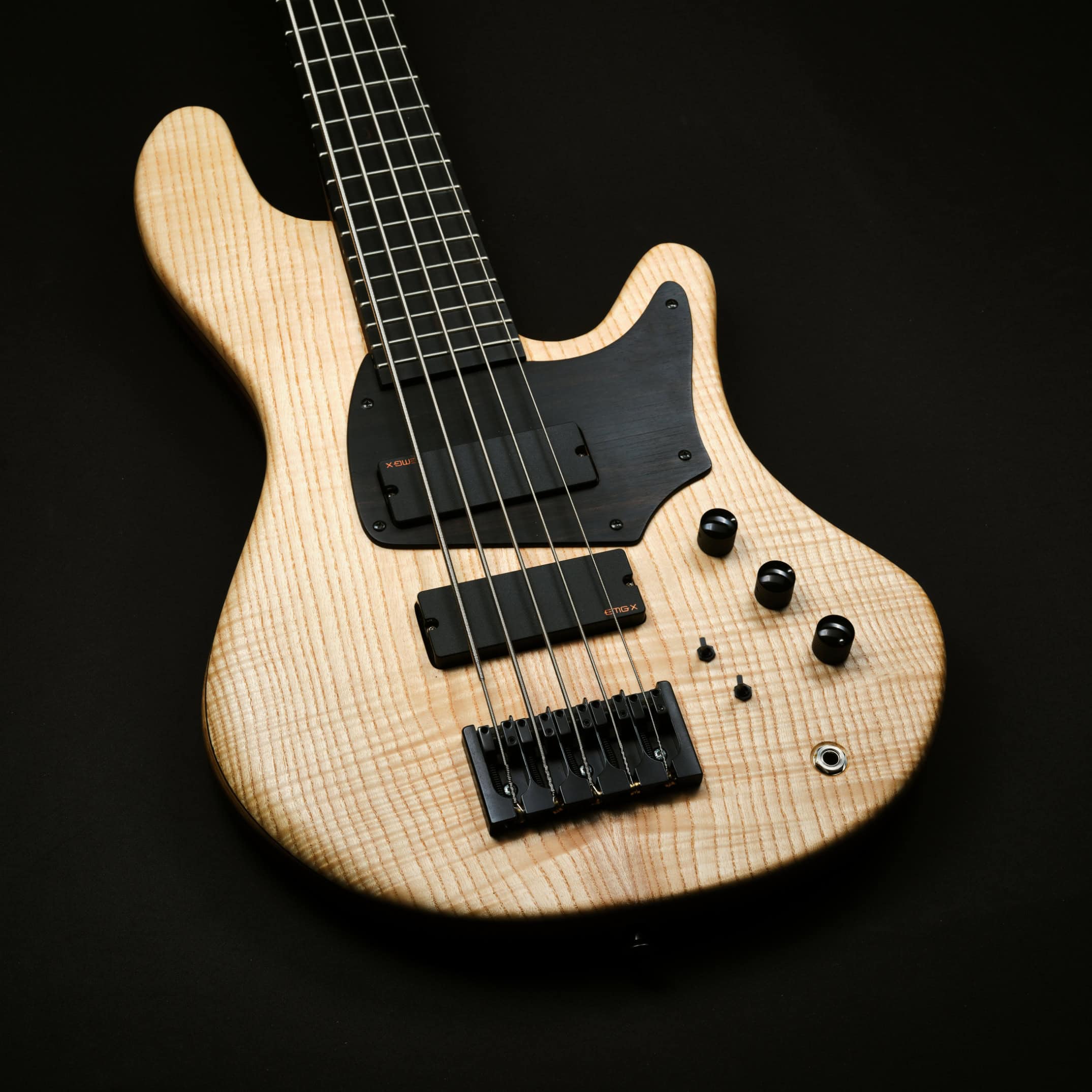
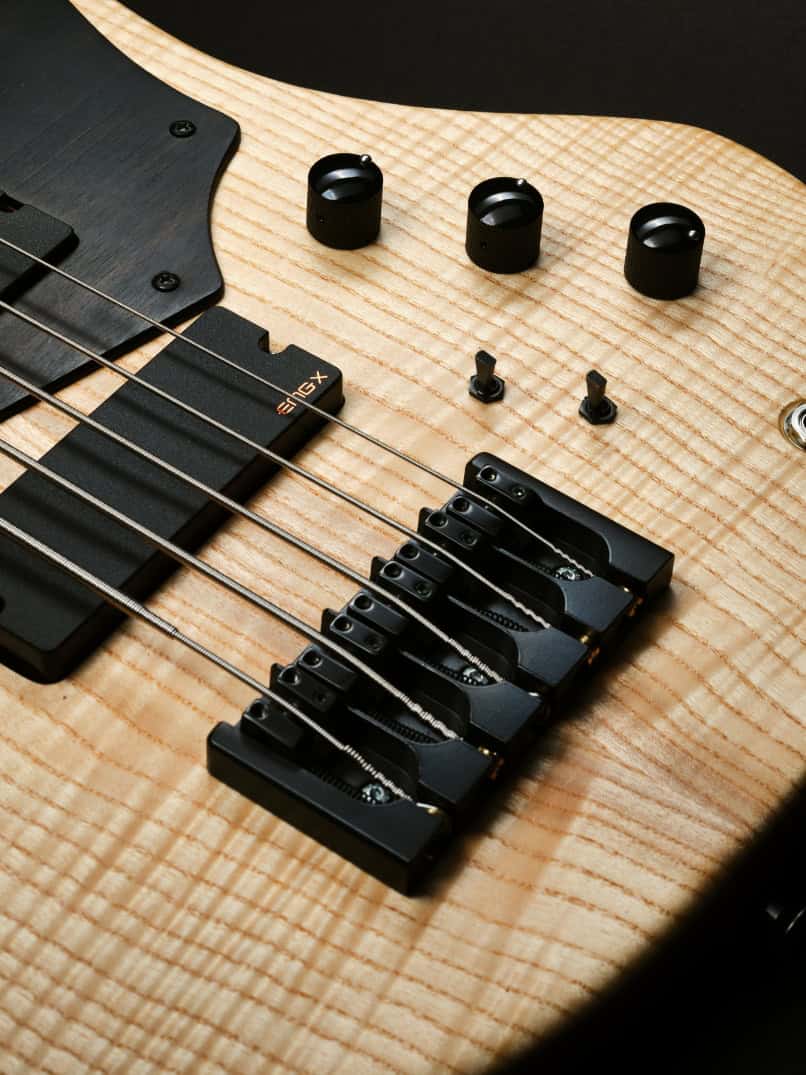
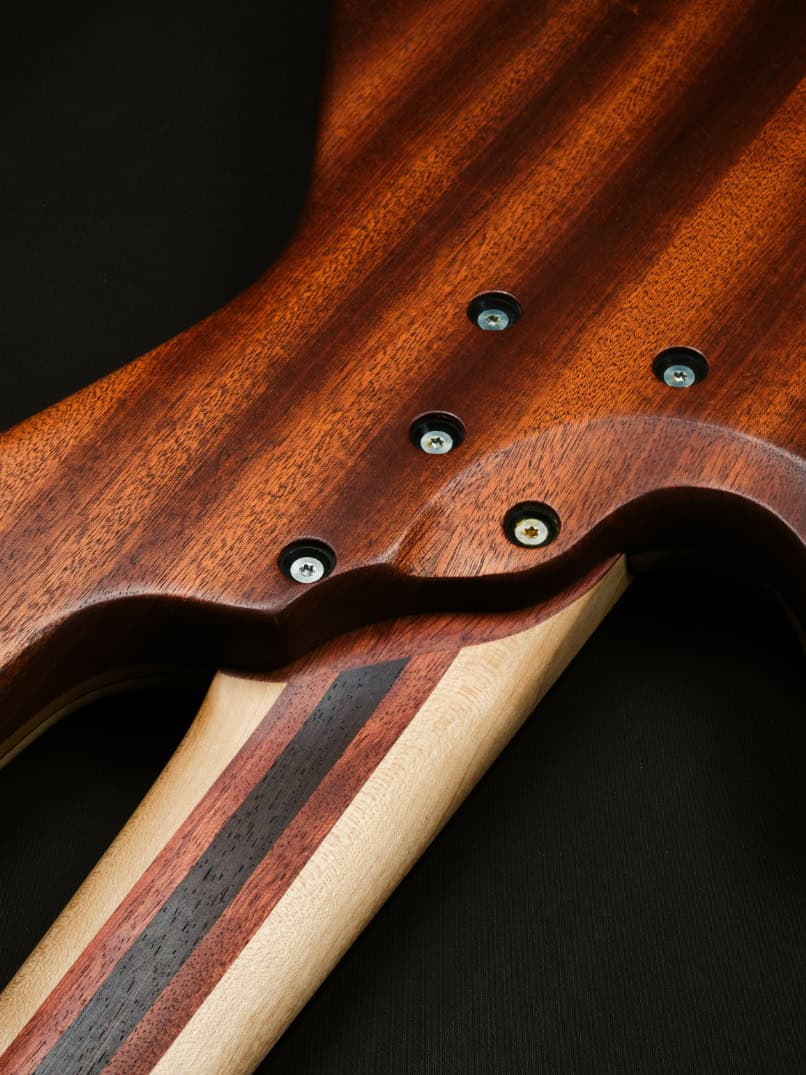
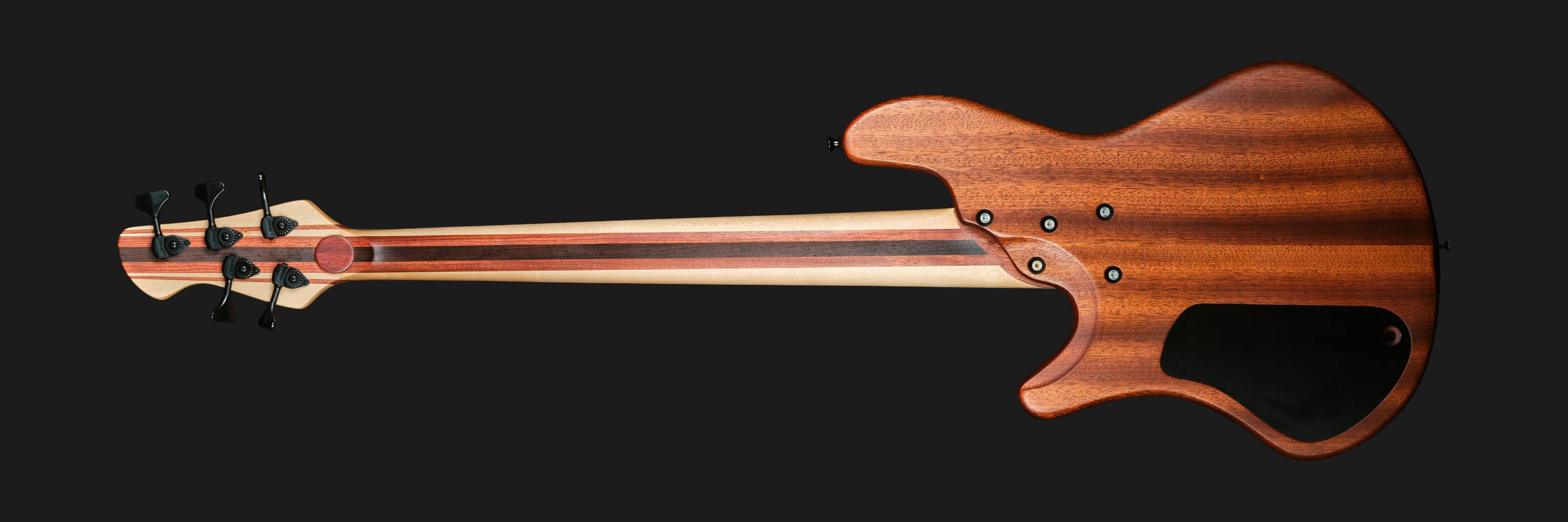
The body is mahogany with a figured ash top, and that pairing does a specific job. Mahogany is the warm half of the equation – a dense, even hardwood with a strong fundamental, a thick low midrange and a slow, generous decay. On its own it can sound a little soft at the top, which is where the ash comes in. Ash is ring-porous and stiff, and laid over a mahogany core it brings back the snap on the attack and the airy top end that mahogany leaves on the table. You get the weight and body of one wood with the definition and sparkle of the other. Left natural under a satin finish, the ash also happens to be the reason you can see what the top is doing – the flame runs right across the open grain, and nothing has been coloured or filled to hide it.
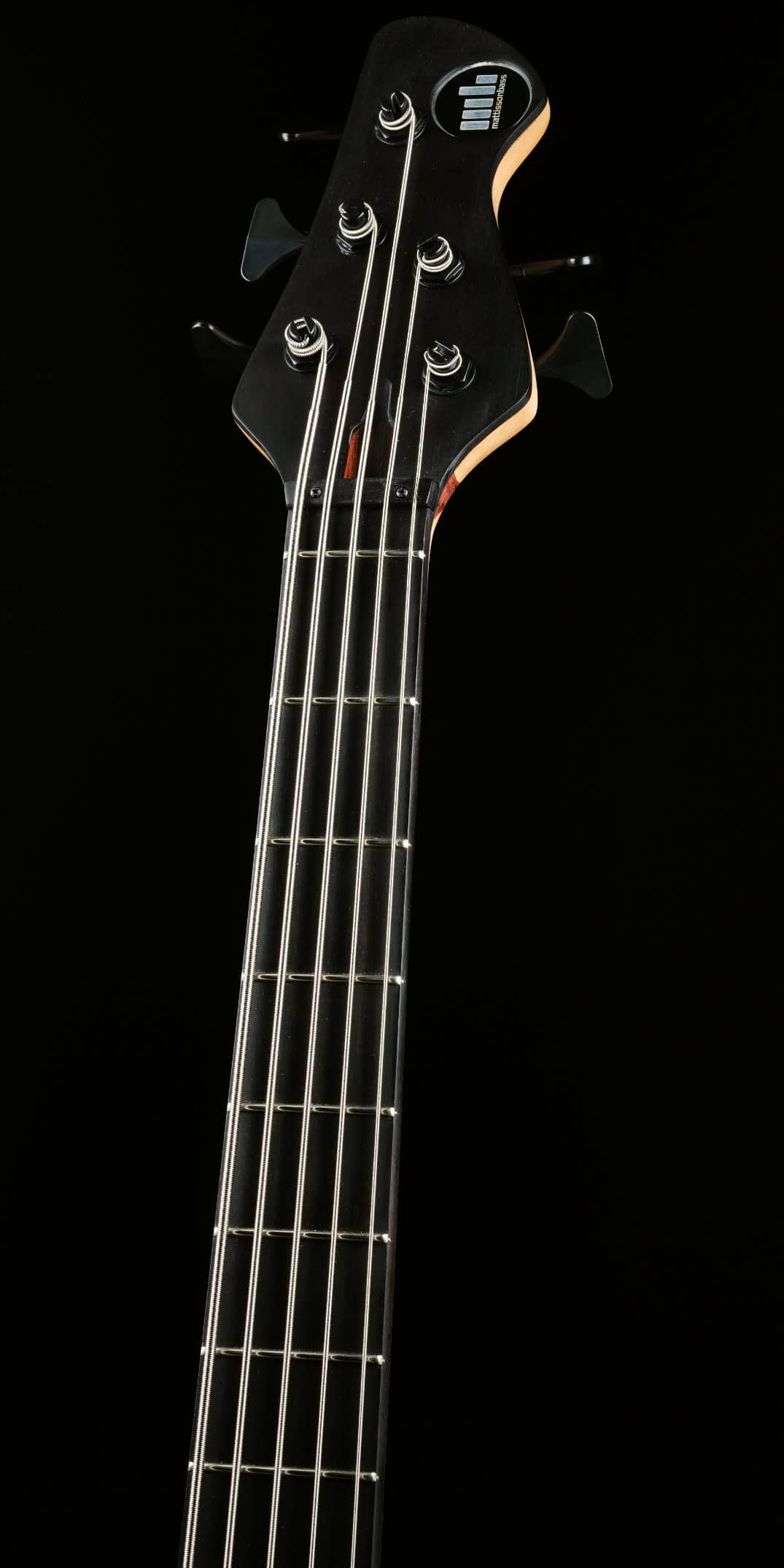
The neck is five pieces: maple on the outside, padouk either side of a wenge centre stripe, all bolted on and finished in wax. Laminating a neck is not decoration. Alternating the grain direction across several pieces cancels out the tendency of any one board to move with humidity, so the neck stays where you set it through seasons and rooms. The three woods are also doing different tonal jobs – maple is bright and stiff, wenge is very stiff and naturally damps the woolly low-mid frequencies that soften a note’s leading edge, and padouk sits between them with a warm, resonant midrange. What you get from the combination is a neck that transmits rather than absorbs. The wax finish keeps it fast: no lacquer film to go tacky under a hot stage light, just sealed wood under your thumb.
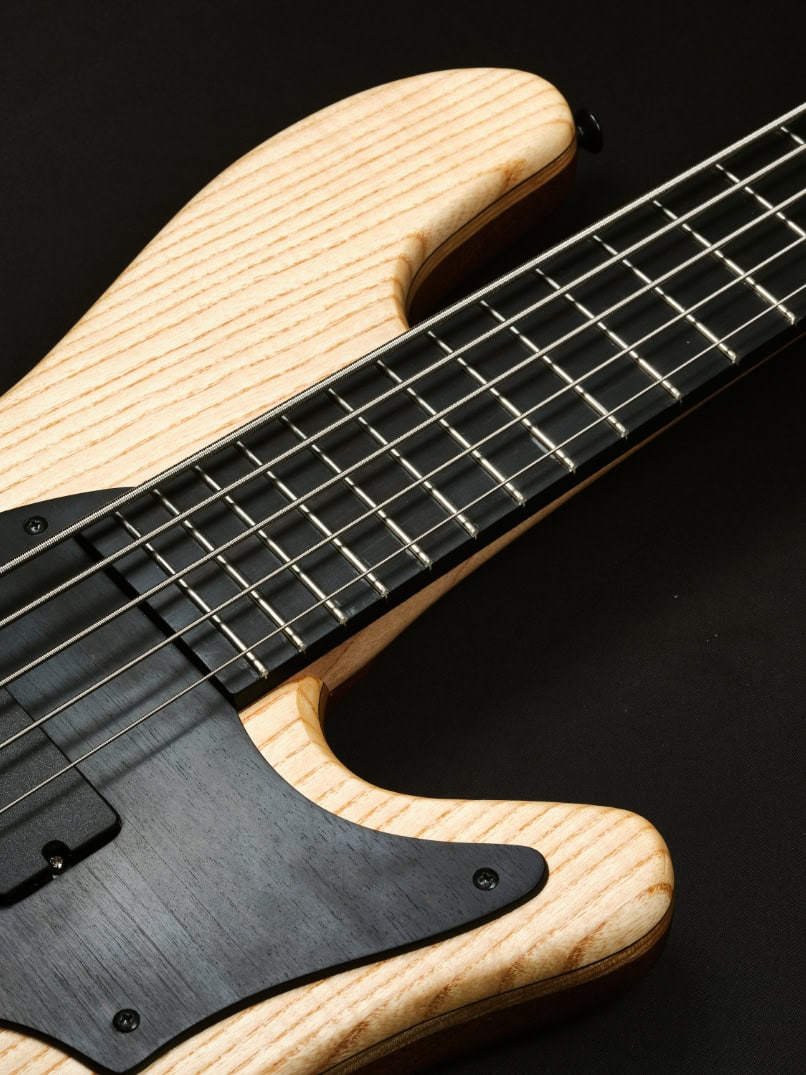
The fingerboard is ebony, and on a five-string it is the sensible choice rather than the fancy one. Ebony is about as hard and dense as fingerboard wood gets, and hardness under the string is what sharpens the attack and keeps the fundamental from smearing. The low B is always the string that suffers first, and a dense board is one of the few structural things that genuinely tightens it. Twenty-four frets take you two full octaves on every string, and the neck joint is cut back far enough that the top of the board is actually usable rather than theoretically present.
There is a zero fret at the top of the board, with a separate string guide behind it. This matters more than it looks like it should. With a conventional nut, the open strings sit in slots cut from bone or plastic – a different material, a different attack and a different decay than every fretted note on the instrument. A zero fret puts the open strings on exactly the same fretwire as everything else, so an open E sounds like a fretted E rather than like a different instrument. It also means the action at the first fret is set by fret height, not by how well somebody cut a nut slot, which is one of the most common reasons a first position feels stiff. The string guide behind it handles spacing and break angle, so each part does one job properly.
The scale is 34 inches – the standard, and a deliberate choice on a five-string when plenty of builders reach for 35″ to buy themselves an easier low B. Going long is the blunt way to solve that problem, and it costs you something: more stretch in first position, a stiffer feel under the right hand, and a set of strings that has to be ordered rather than picked off the wall. Mattisson solve it structurally instead. The B on this bass is held tight by a five-piece laminated neck that will not flex, an ebony board dense enough to keep the fundamental from smearing, and five separate single-string bridges that anchor each string into the body on its own rather than sharing a plate with four others. The result is a low B with a firm, quick attack that still sits under your hand the way a 34″ bass should.
This is a 2024 instrument and it is in mint condition. There is no buckle rash on the back, no wear on the satin top or around the forearm, and nothing on the back of the neck where a wax finish usually shows a player’s hand first. The ebony board is clean and the frets are unlevelled by use – no divots under the D and G in first position, no flattening on the low B. The black hardware has kept its finish, and the Hipshot tuners turn as they should.
The one thing that has changed since it was built is the electronics. The original passive Delano dual coils have been replaced with a pair of EMG 40TW-X, which is why the bass reads as active now where it used to be passive. It was done properly – the pickup routs are clean, the pickguard sits flat and the control layout is unchanged. The two producer toggles were part of the original build and are still not connected to anything.
It comes with the Mattisson gigbag. We have had this bass through the shop once before, so we know what it is and where it has been, and it is priced exactly as it was then.
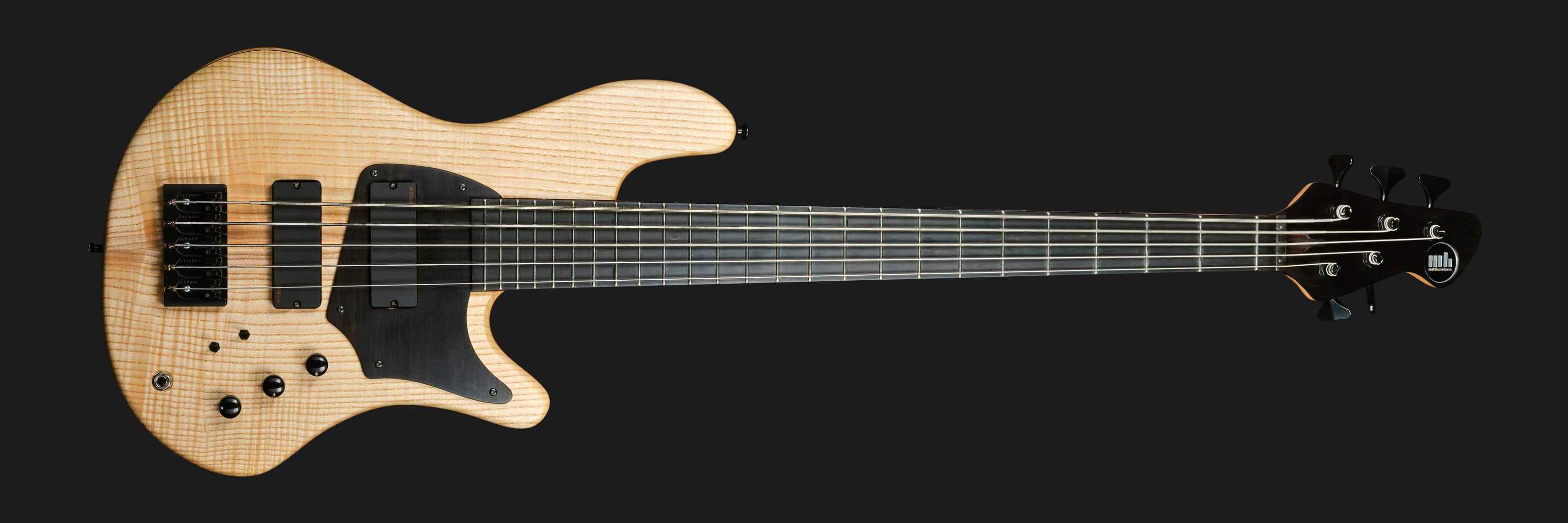
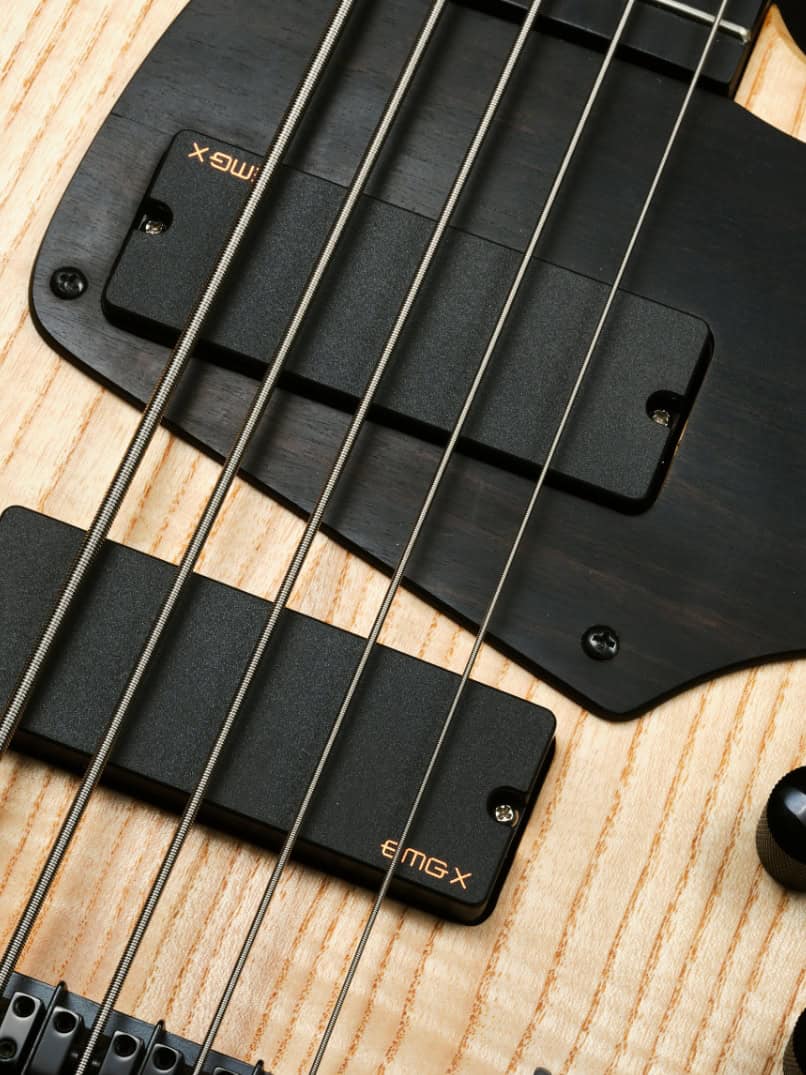
The pickups are a matched pair of EMG 40TW-X. TW stands for Twin, and it means each housing contains two separate pickups rather than one: EMG’s CSX ceramic-steel dual coil, and a JCSX single coil. Switch between them and the character changes properly – the dual coil is the big, aggressive, mid-forward voice with the humbucking silence that goes with it, and the single coil is the leaner, clearer, more open one with the top-end detail and the slight airiness that a genuine single coil gives you. That is two distinct instruments at each pickup position, not a thin split-coil impression of one.
The X in the name is the part worth caring about. EMG’s X Series preamp sits inside each pickup and is a redesign of the circuit that made EMG famous, aimed squarely at the criticism that classic EMGs sound compressed and a bit clinical. X pickups have far more headroom, so hard playing opens up instead of flattening out, and the dynamic response is much closer to a good passive pickup – you hear where your right hand is, and how hard you hit. They still need 9V to run, because the preamp is what makes them work, but the sound they deliver is the modern, open EMG rather than the tight, controlled one from the eighties.
The control set is deliberately plain: volume, volume, tone. Two separate volumes instead of a blend means you set each pickup by ear and can drop either one to zero without hunting for a detent, and the passive tone rolls the top off the whole instrument the way a tone control is supposed to. There is no onboard EQ – all the preamp in this bass lives inside the pickups – which keeps the signal path short and puts the tone shaping back where a lot of players want it, on the amp. And then there are the two producer switches, which do nothing. Neither of them is connected. If you want the 40TW-X coil switching wired up to them, that is a straightforward job and they are already drilled and mounted for it.
Hardware is all black and all chosen for function. The bridge is five separate single-string units, each with its own baseplate, saddle and intonation adjustment, anchored individually into the body – which decouples the strings from one another and lets you set spacing and height per string rather than accepting whatever a one-piece plate dictates. The tuners are black Hipshots, which is about as reliable as bass hardware gets.
Be aware that this is a solid instrument at 4.9 kg. Mahogany, an ash top and a heavily laminated neck all add up. Bring a wide strap. What you get in return is a bass that feels planted, sustains for a long time and has real body behind every note – and a specification that is genuinely hard to buy any other way: a hand-built Swedish five with a zero fret, individual single-string bridges and two pickups that each give you two completely different sounds. This is a bass for a player who already knows what they want and has stopped finding it in the catalogue.
Specs
Body
- Body Wood
- Mahogany
- Top Wood
- Figured ash
- Color
- Natural
- Finish
- Satin
- Pickguard
- Black wood
Neck
- Neck
- 5-piece maple / padouk / wenge, bolt-on
- Neck Finish
- Wax
- Fingerboard
- Ebony
- Scale
- 34"
- Frets
- 24, plus zero fret
- Neck Width at Zero Fret
- 47 mm
- Strings
- 5
Electronics
- Pickups
- 2 x EMG 40TW-X, dual mode (CSX dual coil / JCSX single coil)
- Preamp
- None onboard - the X Series preamp sits inside each pickup, 9V powered
- Controls
- Volume, volume, tone, plus two unwired producer toggles
Hardware
- Bridge
- Five individual single-string bridges, black
- Tuners
- Hipshot, black
- Hardware Finish
- Black
Weight
- Weight
- 4.9Kg
Accessories
- Case
- Mattisson gigbag