Sandberg Basses Nighthawk TM5 Inca Silver Ebony
You might also want to connect with us on Facebook, YouTube, Instagram, or by email.
Out of stock
Nighthawk TM5 Inca Silver
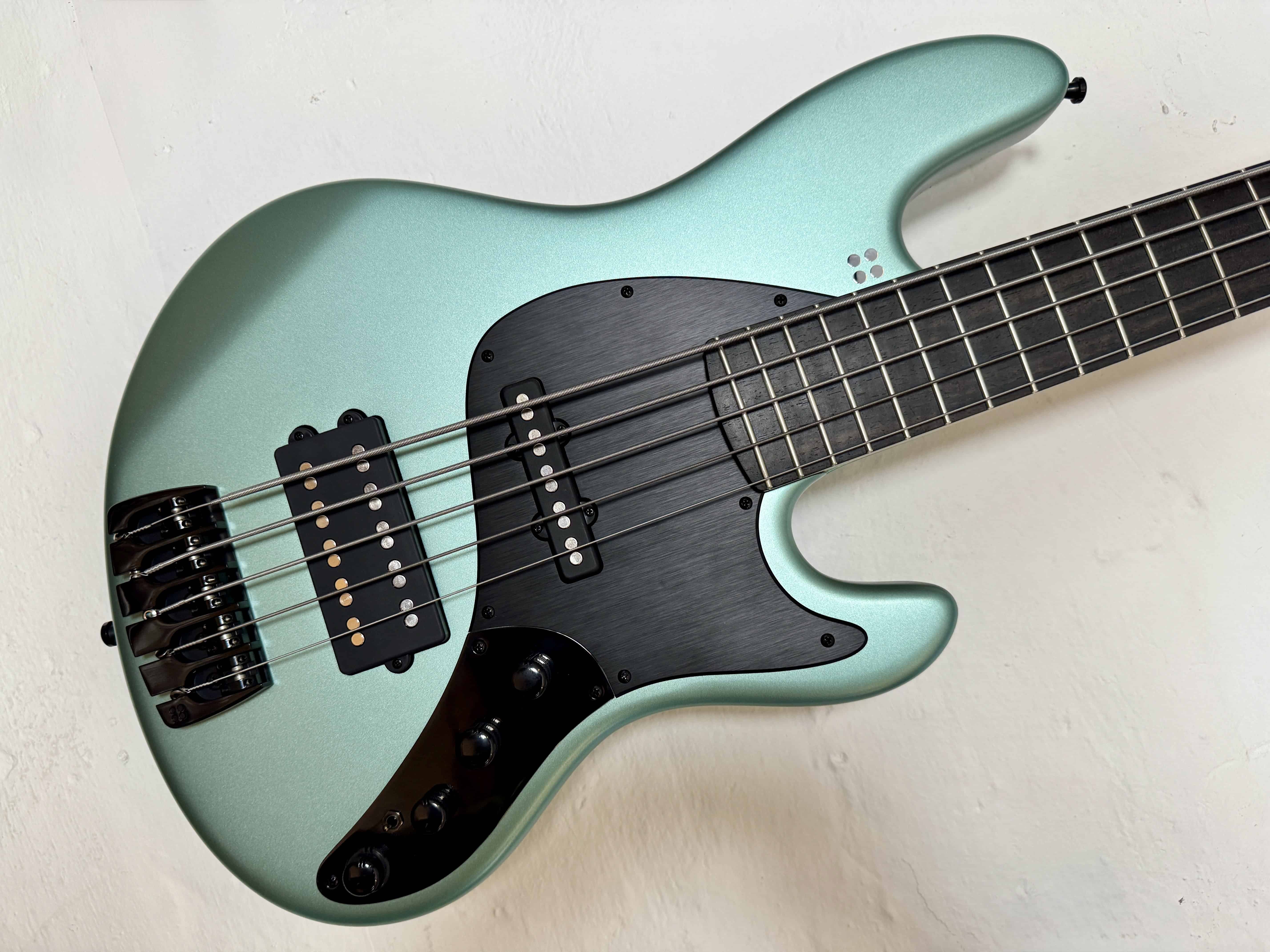
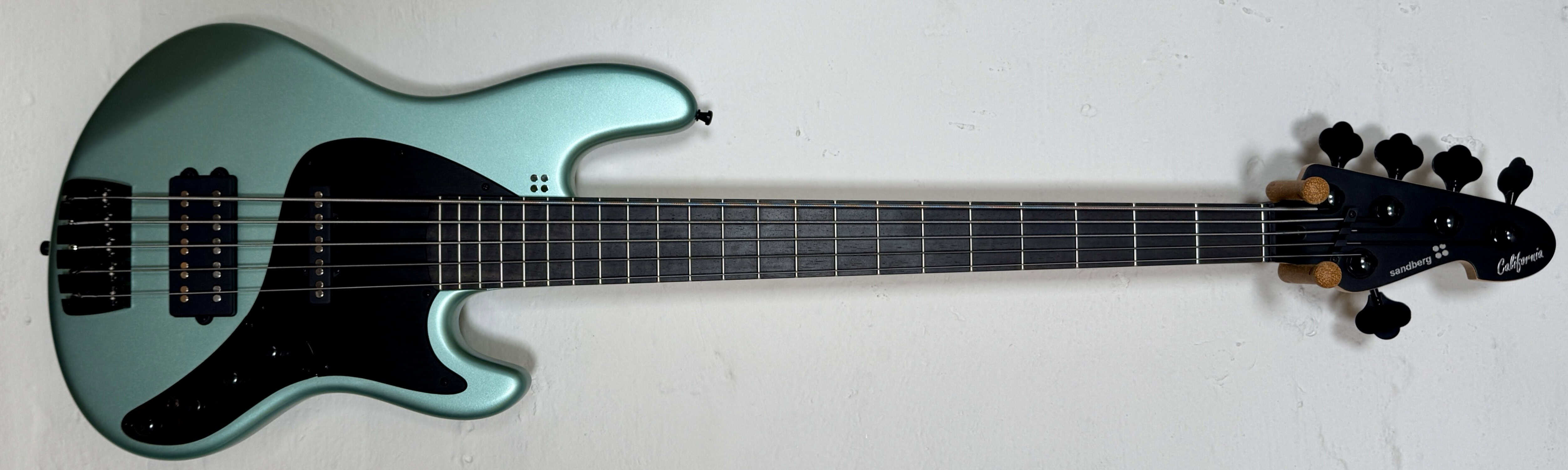
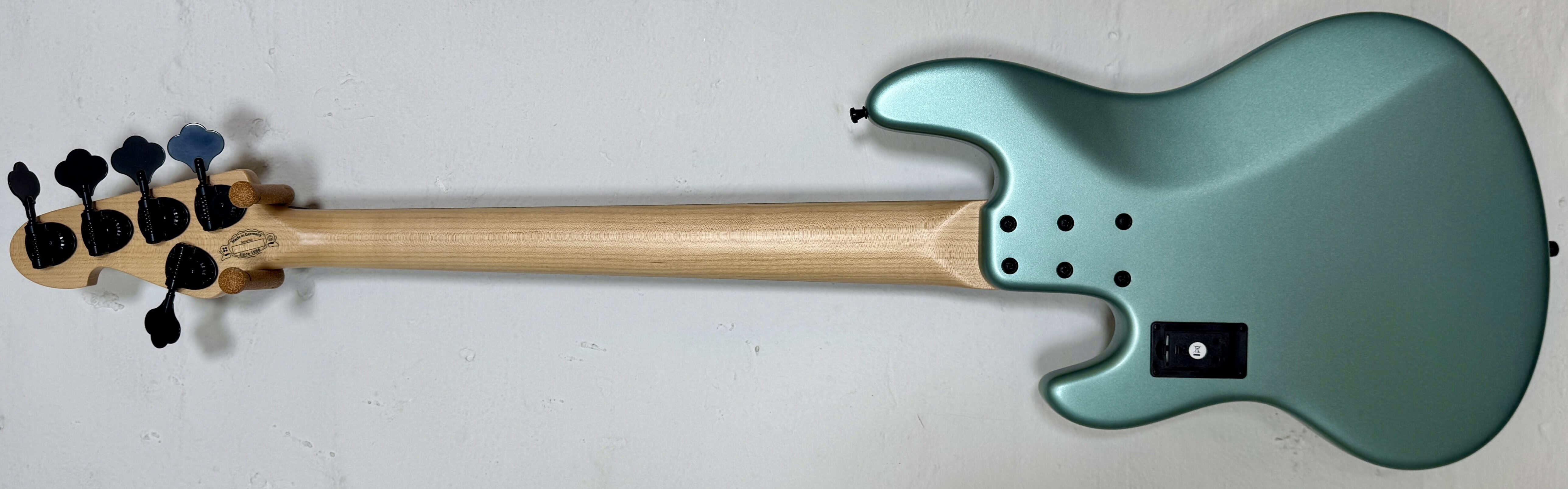
The Nighthawk is what happens when Sandberg takes the California TM and removes every piece of chrome from it. Black tuners, black bridge, black knobs, a black hairline-brushed aluminium pickguard and a black headstock face — and then, instead of the obvious matte black body to go with it, this one arrives in Inca Silver. It is a soft metallic silver-green that shifts toward grey or seafoam depending on the light in the room, and against all that black hardware it looks like nothing else on the wall.
Underneath the paint job it is a working five-string. Single coil at the neck, humbucker at the bridge, a blend knob between them and an active EQ that steps out of the way when you pull the volume. The ebony fingerboard is the upgrade that matters most here — it is not what the Nighthawk normally ships with, and on a five-string it does real work on the low B.
Holger Stonjek has been building basses in Braunschweig since 1986, and Sandberg’s reputation rests on getting the unglamorous things right: fret ends you can run your hand over, a neck pocket with no gap, a finish that is level, and a setup that is playable the moment you take it out of the bag. This one is no different.
All the black hardware of a stealth bass, in a colour that refuses to hide. The ebony board is what makes the low B behave.
Body, Neck & Woods
The body is alder, which is the right call for a two-pickup bass that has to cover ground. Alder gives you an honest low end that stays where you put it, a musical midrange and a top end that opens up without getting glassy — no strong character of its own, which means what you hear is the pickups, the board and your hands rather than the wood pushing the sound in one direction. The California body shape is contoured front and back and sits closer to the ribs than a slab-bodied bass, so an hour into a set your right forearm still thanks you for it.
The neck is Canadian hard rock maple, bolted on with six screws instead of the usual four. That extra pair spreads the clamping load across the heel, keeps the joint from working loose over years of seasonal movement and couples neck to body more tightly — you hear it as a firmer fundamental and longer sustain. The profile is a C-shape, full enough to fill your hand without slowing it down, and the satin back means no drag when the stage gets warm. The heel is sculpted, so the top frets are genuinely reachable.
The fingerboard is ebony, and that is the spec worth paying attention to. Ebony is the hardest and densest board wood in common use, and its job is definition: it sharpens the leading edge of every note, speeds up the attack and keeps the fundamental from smearing. On a five-string that is not cosmetic. The low B is the string that most often turns to mush, and a dense board is one of the few things that genuinely tightens it. On this one the board is black, unbound and free of face dots, which is why the neck looks like a single dark line running down the middle of the instrument.
There is a zero fret at the top of the board, and it is one of Sandberg’s better ideas. Instead of the open strings resting in a slotted nut, they sit on a fret exactly like every other note — same material under the string, same attack, same decay — so an open E actually sounds like a fretted E. It also means the action down at the first position is set by fret height rather than by how well somebody cut a nut slot, which is the single most common reason a bass feels stiff in the first three frets. A separate string guide behind it sets the spacing, so the two jobs are split between two parts that each do only what they are good at.
The scale is 34 inches with a 14-inch fingerboard radius and 44.6 mm across the zero fret. That is deliberately familiar territory — if you have played a Jazz-style five before, your left hand knows this neck immediately. The flatter radius is what makes it feel modern: it keeps the action even across all five strings and lets you set it low without the outer strings choking when you bend.
Electronics, Sound & Feel
The pickups are Sandberg’s own Black Label set — a T-style single coil up at the neck and an M-style humbucker at the bridge. It is a smart pairing rather than a traditional one. The single coil covers the round, vocal, slightly hollow sound that fingerstyle players live on, while the bridge humbucker brings the mid punch and the growl, plus it is quiet under stage lighting where a bridge single coil would be buzzing. The blend knob is where the bass really lives: neck alone for the fat, old-school voice, both together for the scooped modern sound that slap players want, bridge alone for a hard, forward tone that cuts straight through two guitars.
Behind them sits Sandberg’s 3-band preamp — treble, middle and bass, all with boost and cut — squeezed onto four pots by stacking the bass and middle controls on one shaft. The middle band is the one worth learning. It is where a bass either sits in a mix or disappears into the guitars, and having a proper cut and boost there means you can carve a hole for a busy guitar player or push the whole instrument forward in a sparse trio without touching the amp.
The volume knob is a push-pull that takes the preamp out of the circuit entirely. Passive mode is not just a battery-failure escape hatch — it is a genuinely different sound, softer at the edges, more compressed, a bit springier in the low mids — and having it a knob-pull away means you can change the whole character of the instrument between songs. It also means a flat 9V costs you a knob-pull rather than the gig.
The hardware is Sandberg’s own throughout, all in black. The bridge has real mass under the saddles, which feeds sustain and low-end definition back into the body, and the string spacing adjusts between 18 and 19.5 mm so you can set the strings where your right hand actually wants them. The lightweight tuners keep mass off the headstock, and on a five-string that is the difference between a bass that hangs level on a strap and one that pulls toward the floor over a two-hour set.
This is the bass for the player who wants one instrument to cover the whole gig. The single coil and humbucker between them handle everything from Motown to modern pop and rock, the ebony board and 34″ scale keep the low B tight and articulate rather than woolly, and the passive mode gives you somewhere to go when the active sound is too much. Nighthawks usually turn up in matte black or dark grey — this one came through in Inca Silver with an ebony board, and it is the only one we have.
Specs
Body
- Body Wood
- Alder
- Color
- Inca Silver
- Finish
- Matt
- Pickguard
- Black hairline-structure aluminium
Neck
- Neck
- Canadian hard rock maple, bolt-on (6-bolt)
- Neck Profile
- C-shape
- Fingerboard
- Ebony
- Scale
- 34" (864 mm)
- Frets
- 22, plus zero fret
- Fret Size
- 2.7 mm
- Fingerboard Radius
- 14"
- Width at Zero Fret
- 44.6 mm
- Strings
- 5
- Headstock
- Black face
- Tuning
- Standard
Weight
- Weight
- TBA
Electronics
- Pickups
- Sandberg Black Label T-style single coil (neck) and M-style humbucker (bridge)
- Preamp
- Sandberg 3-band EQ, switchable active / passive
- Controls
- Volume (push/pull active/passive), Blend, Treble, stacked Bass / Middle
Hardware
- Bridge
- Sandberg
- Bridge Spacing
- 18 mm to 19.5 mm
- Tuners
- Sandberg lightweight
- Hardware Finish
- Black
- Includes
- Sandberg gigbag