Lakland US 4-94 Deluxe Quilted Maple (pre-owned)
In stock
US 4-94 Deluxe — Chicago, 1999
Lakland started in Chicago in 1994, when Dan Lakin and luthier Hugh McFarland set out to build the bass they could not buy — a bolt-on four with Fender bones, Music Man punch and a build standard neither of those companies was offering at the time. The model they landed on took its name from the year it appeared, and it is still the instrument the whole company is measured against. Early ones like this were simply the 4-94; the second digit only arrived later, when the range grew and the four became the 44-94 and the five the 55-94.
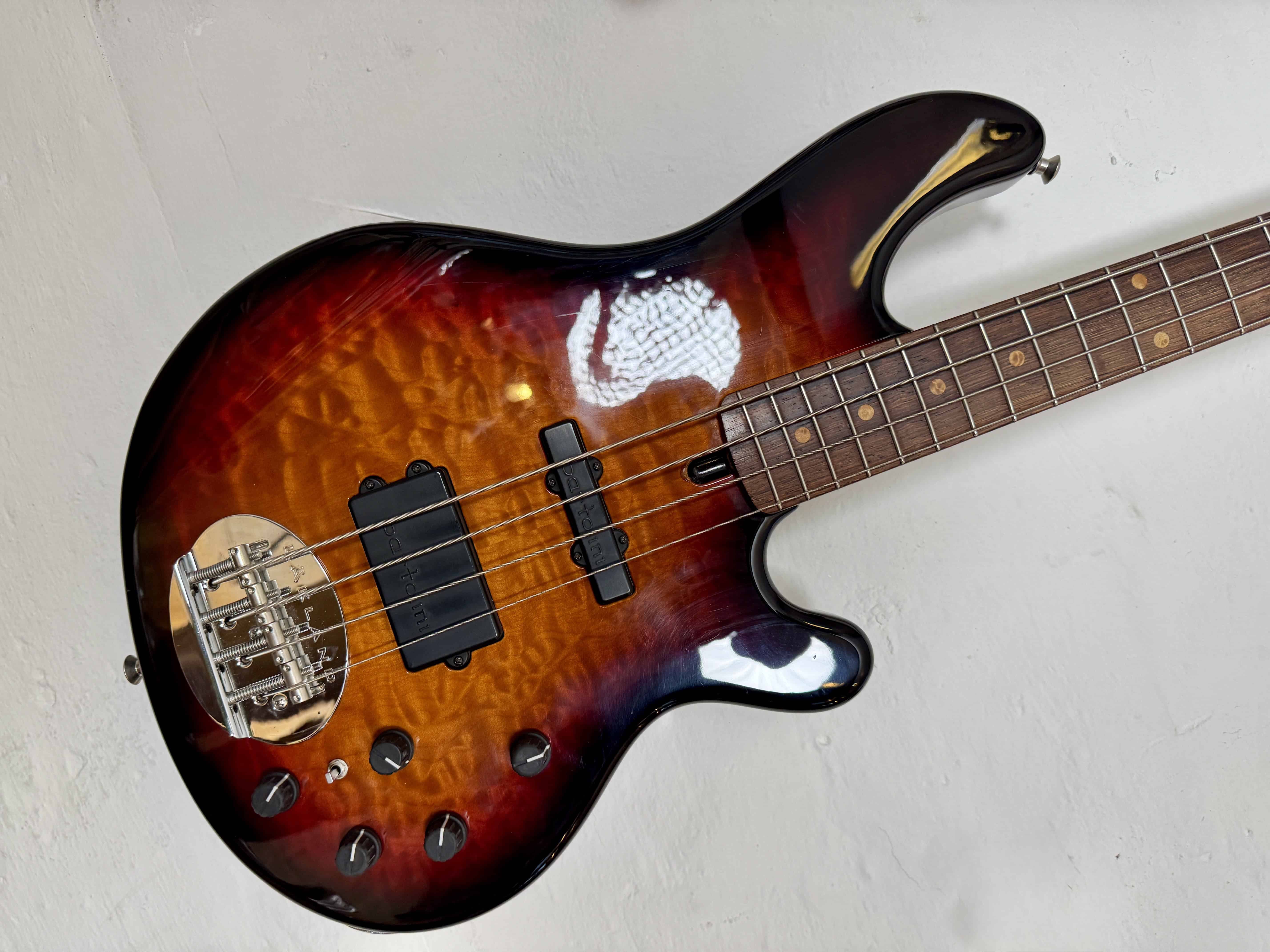
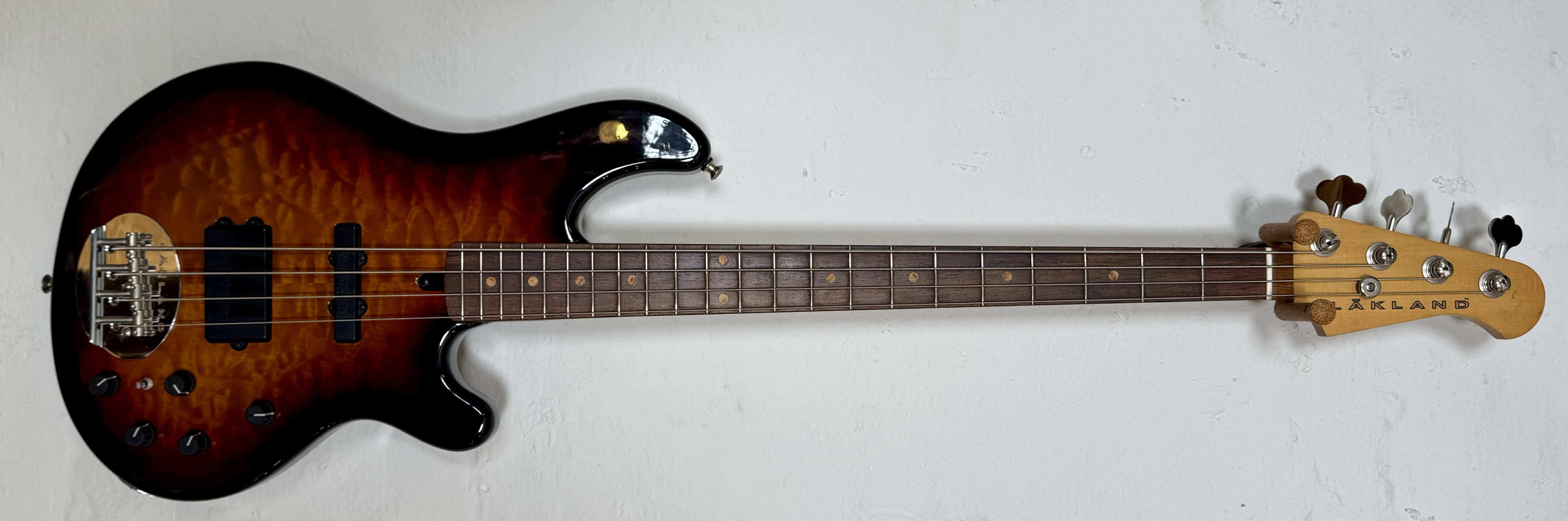
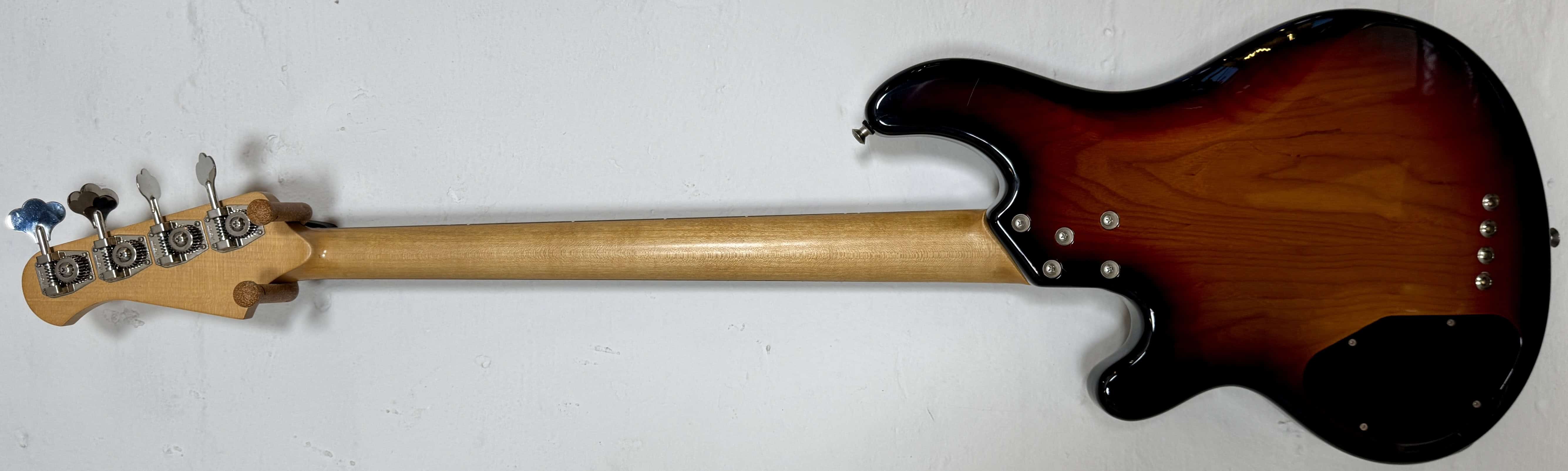
This one is a 1999 Deluxe, which is the appointment package with the figured top and the full three-band Bartolini circuit. The quilted maple cap is bookmatched with the figure running unbroken across the centre seam, and the three-tone sunburst is laid on so the quilt stays visible right into the dark outer ring instead of drowning in it. Under gloss, with the ash grain still showing through the burst on the back — an early Chicago build, and it looks it.
Lakland built its entire reputation on this one model, and ten minutes with an early Chicago-built 4-94 tells you exactly why they never needed a second idea.
Body, Neck & Woods
Swamp ash body with a bookmatched quilted maple top. Swamp ash is the light, open-pored end of the ash family, and it is the reason a 4-94 has that big, airy fundamental with a scooped midrange and a genuinely bright top — the note blooms rather than thuds. The maple cap on top firms all of that up: it tightens the attack, adds the high-end snap that makes the bridge pickup bark, and stops the ash from getting woolly when you dig in. Forearm bevel and belly cut are both there, so it sits against you like a Jazz bass rather than a slab.
The neck is quartersawn hard rock maple, bolted on through Lakland’s five-bolt joint — quartersawn because the growth rings run vertically through the blank, which is the single most effective thing you can do to keep a maple neck from moving with the seasons. The rosewood fingerboard carries 22 frets over a 10″ radius with pearl dots, and the nut is cut from bone at 1.6″ / 40.6 mm. That is a hair wider than a Jazz bass at the nut and it makes a real difference under the first three frets, where a 40 mm nut gives your fretting hand somewhere to go.
34″ scale, with 0.78″ / 19.8 mm spacing at Lakland’s own dual-load bridge. That spacing is fractionally wider than the 19 mm you get on a Jazz bass, which is exactly the margin slap players ask for without pushing the right hand out into five-string territory. The bridge takes strings either through the body or top-loaded, so you can choose how much break angle and how much tension you want behind the saddles — through-body for a stiffer, more focused feel, top-load if you prefer a little more give under the fingers.
Condition
Very good condition for a bass that has been out in the world since 1999. The gloss on the quilted top is clean, with only a few small dings and scratches, no cracks and no buckle rash across the back — the kind of light handling marks any twenty-seven-year-old instrument picks up, visible when you tilt it into the light rather than something you notice across a room. The sunburst is unfaded and the ash grain still reads clearly through the finish on the back of the body.
The frets show light playing wear with plenty of life left in them — no divots under the first-position strings and nothing that needs addressing before you gig it. The rosewood board is clean and evenly coloured, all the dot inlays are intact, and the neck is straight with the truss rod working through its full range. The satin on the back of the neck has worn slightly smooth in the first-position area, which is what a well-played maple neck is supposed to look like.
Electronics are all original and fully working: the NTMB-L is quiet, the blend sweeps cleanly between the two Bartolinis, all three EQ bands cut and boost as they should, and the coil selector and passive bypass both do their job. The chrome hardware is bright with no pitting on the bridge plate or the tuner housings. It comes in a hardshell case — not the original, but a proper fitted one.
Electronics, Sound & Feel
The pickup layout is the whole argument for this model. A Bartolini MM42K3 humbucker sits in the Music Man position at the bridge, and a Bartolini 9K-S3 J-style sits up at the neck. Solo the bridge and you get the burp and the midrange bite that a Music Man pickup in that exact spot has been putting on records since the seventies, but with Bartolini’s smoother, less brittle top end. Roll the blend forward to the neck pickup and the whole thing widens out into fundamental and warmth. The useful part is everything in between — because the two pickups are so far apart, the blend control is a genuine tone sweep rather than a small variation on one sound.
Behind them is the Bartolini NTMB-L, the three-band circuit Lakland specified for the 94 series and the one most players mean when they talk about the early US Lakland sound. Volume, pickup blend, and cut/boost on bass, mid and treble, with the volume knob pulling up to bypass the preamp entirely and run the bass passive — worth knowing about, because passive mode is a real, usable second voice on this bass and a working backup if a battery ever dies mid-set. The mini toggle on the face is a three-position coil selector for the bridge humbucker: one outer coil on its own for a thinner, more single-coil snarl, both coils for the full humbucking punch, or the inner coil for something rounder and closer to the neck. Inside the cavity there is a mid-frequency selector and an output trim, so the midrange band and the overall system gain can both be set to suit the amp you actually use.
What you get in practice is an extremely versatile working bass that never sounds generic. It slaps like a Music Man, fingerstyles like a Jazz, and the preamp has enough range to make either of those sit properly in a mix without touching the amp. Early US Laklands are getting genuinely hard to find in Europe — Chicago-built, original Bartolini electronics, a quilt top like this one — and they are still built to a standard that most of what gets called boutique today only aspires to. If you want one instrument to cover a whole set, this is the shortlist.
Specs
Body
- Body Wood
- Swamp ash
- Top
- Bookmatched quilted maple
- Colour
- Three-tone sunburst
- Finish
- Gloss
- Contours
- Forearm bevel and belly cut
Neck
- Neck Wood
- Quartersawn hard rock maple
- Construction
- Bolt-on — 5-bolt joint
- Fingerboard
- Rosewood
- Fingerboard Radius
- 10"
- Frets
- 22
- Scale
- 34"
- Nut
- Bone — 1.6" / 40.6 mm
- Inlays
- Pearl dots, side dots
Electronics
- Bridge Pickup
- Bartolini MM42K3 — MM-style humbucker
- Neck Pickup
- Bartolini 9K-S3 — J-style
- Preamp
- Bartolini NTMB-L — 3-band active, cut and boost
- Controls
- Volume (pull for passive bypass), pickup blend, bass, mid, treble
- Switching
- 3-position coil selector for the bridge humbucker
- Cavity Trims
- Mid-frequency selector and output trim inside the control cavity
Hardware
- Bridge
- Lakland dual-load — top-load or through-body, 0.78" / 19.8 mm spacing
- Tuners
- Hipshot open-gear, clover keys
- Hardware Colour
- Chrome
- Strap Buttons
- Standard — no straplocks fitted
Weight
- Weight
- 4.02 kg / 8.9 lbs
Accessories
- Case
- Hardshell case — not original
- Case Candy
- None
- Strap & Cable
- Not included