Sandberg Basses Custom Stripe Fretless 4 (pre-owned)
In stock
A Sandberg Custom, Built in Stripes
Sandberg have been building basses in Braunschweig since 1986, when Holger Stonjek moved out of piano making and set up shop in an old farm building on a street called Am Sandberg — which is where the name came from. The company made its reputation on exotic, one-off five- and six-string builds long before the California line made them a household name, and this bass is a direct descendant of that side of the workshop.
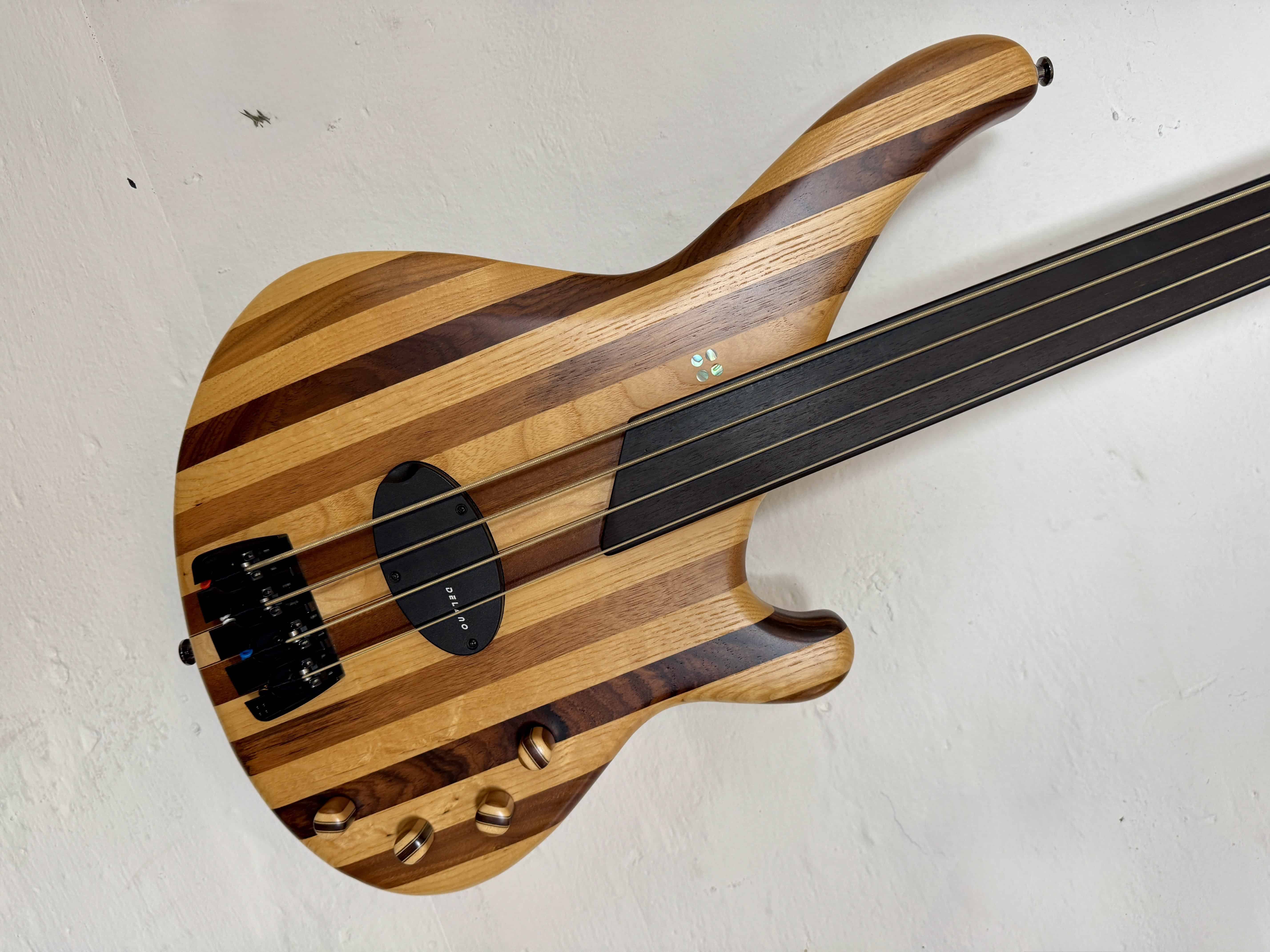
It is a custom order from 2012, and it is not a model you will find in a catalogue. What you get instead is the Custom Series recipe — five-bolt Canadian hard rock maple neck, Delano X-Tender pickup, Sandberg’s own 3-band preamp — wrapped around a body that somebody sat down and designed one stripe at a time.
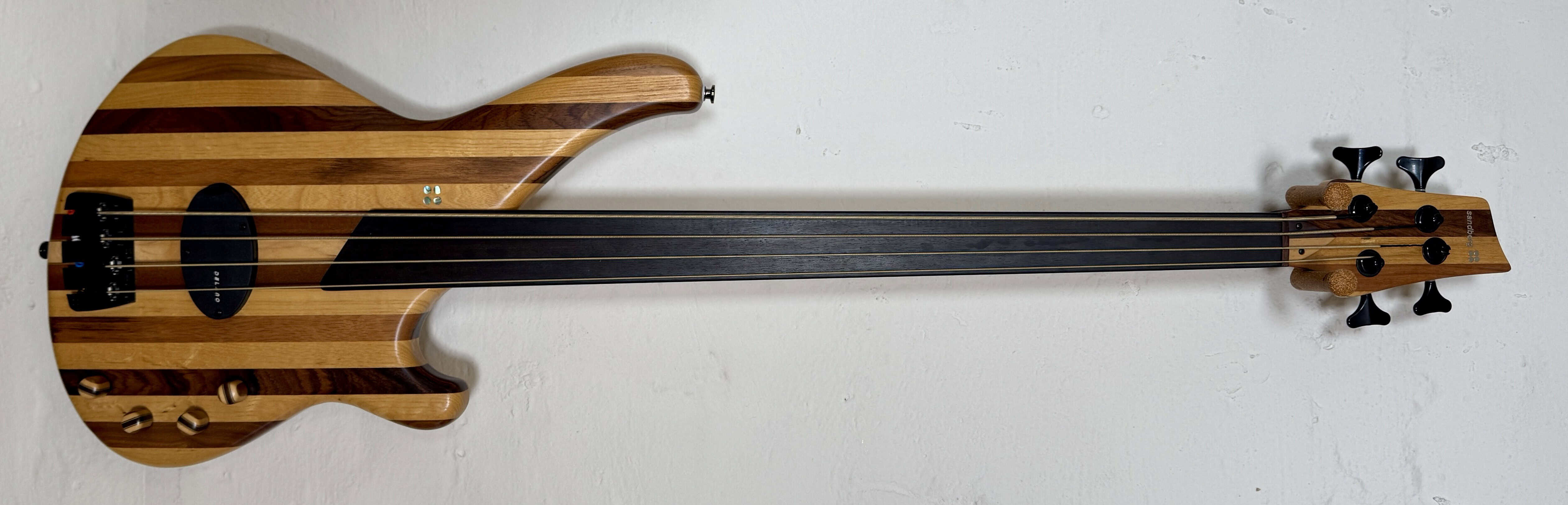
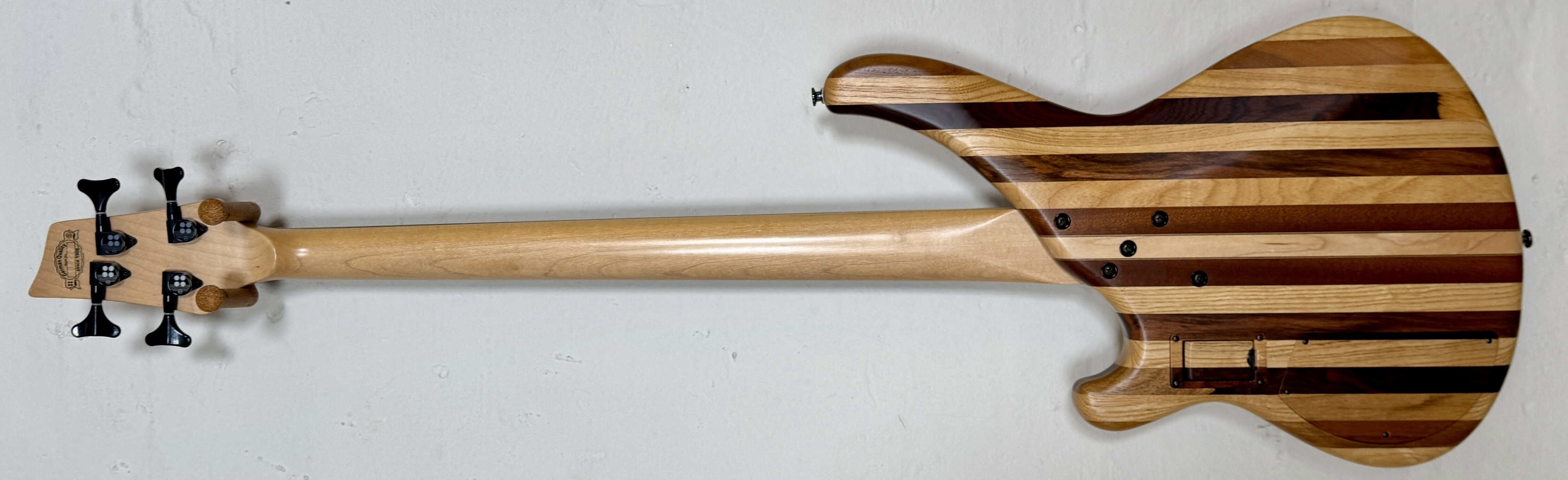
Six woods, one body, and the same stripe running clean through the back. This is what a German workshop does when somebody gives them permission.
Body, Neck & Woods
The body is a laminate of six woods — ash, maple, walnut, cocobolo, rosewood and mahogany — and the important detail is that it is a true through-body laminate, not a striped top glued onto a plain blank. Turn the bass over and the same stripes carry on across the back in the same order. That is a much harder thing to build, and it is why the instrument does not read as decorated so much as constructed.
Tonally, a multi-laminate body behaves differently from a two-piece one. All those glue lines running perpendicular to the string path stiffen the body and damp the broad, lazy resonances a single slab of ash will give you. What comes back is a tighter fundamental and a faster note decay — you hear the string more and the box less. On a fretted bass that can read as clinical. On a fretless it is exactly what you want, because it keeps the note defined while you are moving through it.
The neck is Canadian hard rock maple on a five-bolt joint into a sculpted heel, with an unlined ebony fingerboard over a 34″ scale. Unlined is the purist’s choice and it asks something of you — there is nothing on the face of the board to aim at except the side dots. Ebony is the right wood for it: hard, dense and tight-grained, so it takes roundwound traffic better than rosewood and gives the attack a glassy edge that carries the mwah. The only marking on the board face is Sandberg’s four-dot logo inlaid in abalone, which is a lovely piece of restraint.
Condition
Excellent throughout. This is a fourteen-year-old instrument that has clearly been looked after, and the finish, the hardware and the neck are all in the shape you would hope for.
The one thing worth calling out is a small amount of finish wear at the edge of the battery compartment on the back, where the cover gets levered open. It is cosmetic, it is where you would expect it on any active bass of this age, and you will not see it while you are playing. The ebony fingerboard is in good shape with no grooving or divots — on a fretless of this vintage that matters more than anything else on the list.
Electronics, Sound & Feel
One Delano TheXtender dual coil sits between the neck and the bridge. Delano build these by hand in Germany, and the oval shell is not styling — it houses a magnet array and string-sensing pattern that is deliberately different from a conventional soapbar, reading a wider slice of the string’s motion rather than a narrow window. Delano’s own words for it are massive bottom, gutsy midrange growl and a wide-open top end, and that is a fair description. It is hum-cancelling, which on a single-pickup bass matters more than usual — you have nothing to blend against to kill noise.
That feeds Sandberg’s own 3-band preamp, laid out across four knobs: volume, bass, middle, treble. The sweepable middle is the one that earns its keep on a fretless. Push it and the mwah sits forward in a band mix instead of disappearing under a guitar; pull it back and you get a rounder, more upright-adjacent voice for quieter work. Bass and treble are voiced gently enough to be usable at the extremes rather than as on-off switches. Power is a 9V in a rear compartment, so no unstringing to change a battery.
At 3.95 kg it hangs nicely — light for a body this dense, and the upper horn reaches far enough that it balances rather than dives. Even the knobs are cut from the same laminate stock as the body, which tells you something about how the order was specced. This is a fretless for a player who already knows they want unlined and wants a voice that stays articulate rather than washing into mush. We do not expect to see another one like it, because there is not another one like it.
Specs
Body
- Body Wood
- Six-wood laminate: ash, maple, walnut, cocobolo, rosewood and mahogany
- Construction
- Solid body, through-body laminate — the striping runs front to back
- Finish
- Natural, clear
Neck
- Neck Wood
- Canadian hard rock maple
- Fingerboard
- Ebony, unlined
- Construction
- Bolt-on, 5-bolt
- Scale
- 34"
- Frets
- Fretless
- Inlays
- Abalone Sandberg four-dot logo on the fingerboard face
Electronics
- Pickup
- 1x Delano TheXtender 4 dual coil
- Preamp
- Sandberg 3-band active
- Controls
- Volume, bass, middle, treble
- Power
- 9V battery, rear compartment
Hardware
- Bridge
- Individual single-string bridges, black
- Tuners
- Sandberg, black
- Hardware Finish
- Black
- Knobs
- Laminated wood, cut from the same stock as the body
Weight
- Weight
- 3.95 kg
Accessories
- Case
- Gig bag included
- Case Candy
- None
- Strap & Cable
- Not included